Do you ever feel like you’re paying too much for car insurance? It’s one of the biggest regular expenses for most households, yet the price for the exact same coverage can change by hundreds, even thousands, of dollars from one company to the next. It’s a confusing market, and countless drivers overpay because they don’t know where to find the best deal.
Imagine finding out that you could lower your car insurance bill significantly without giving up the important protection your family relies on. The key isn’t just finding a “cheap” company, but finding the right one for your unique situation. Factors like your age, driving record, the car you own, and even your location create a personal profile that different insurers price in completely different ways. What’s cheapest for your neighbor might be expensive for you.
Picture the peace of mind that comes from knowing you’ve secured one of the most competitive car insurance rates available. Think about what that extra money in your pocket each month could mean—paying down debt faster, saving for a family vacation, or just having more financial breathing room. This guide is built to give you that confidence. We’ve done the hard work, analyzing millions of rates to create a clear roadmap for you to follow.
In this complete guide, we will show you how to find the lowest rate car insurance companies for every type of driver. You will learn how to effectively shop for car insurance, compare quotes from multiple companies online, and lock in the best possible price for the coverage you need. Let’s start your journey to smarter savings now.
First Glance: The Cheapest Car Insurance Companies of 2025
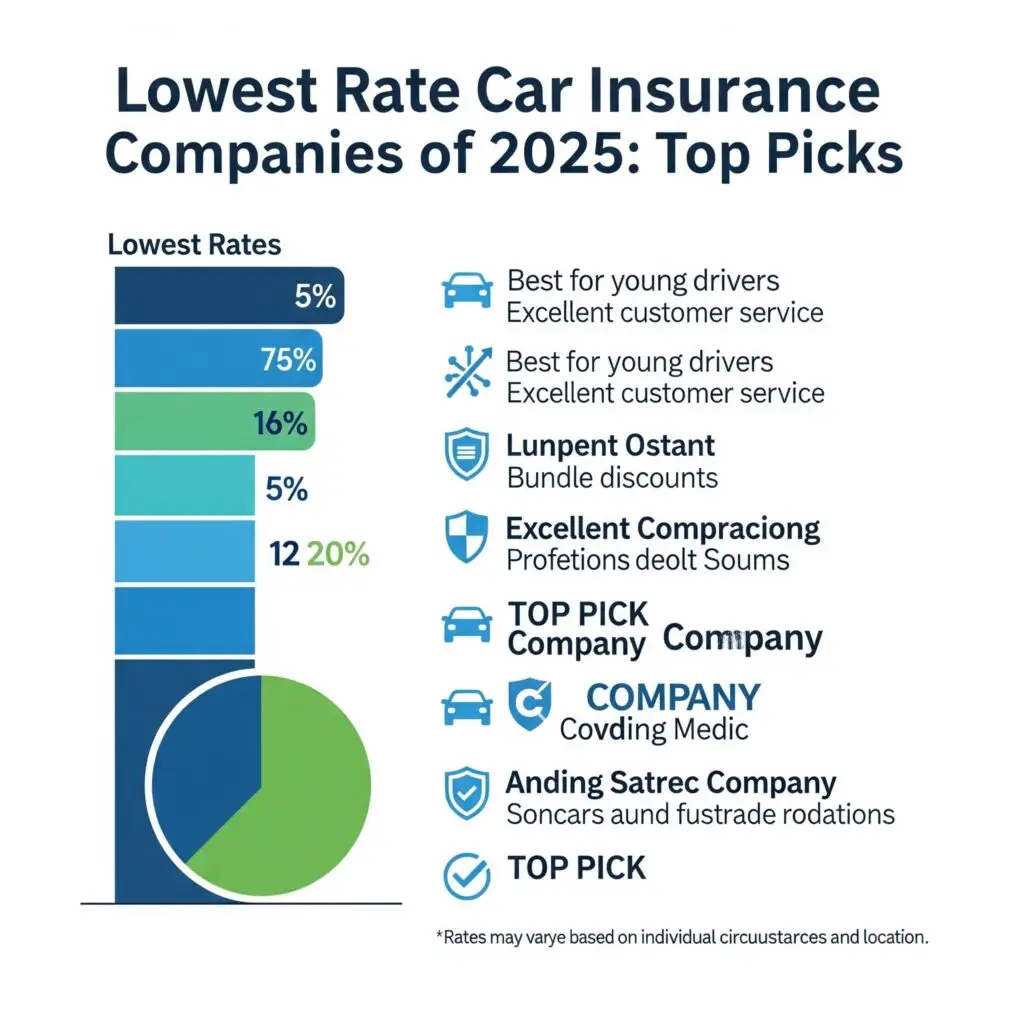
For those who want a quick answer, our in-depth 2025 rate analysis reveals the most competitive car insurance rates from the nation’s top providers.
- Lowest Rate for Full Coverage: Travelers consistently offers the most affordable rates for drivers seeking comprehensive and collision protection.
- Lowest Rate for Minimum Liability Coverage: GEICO is the front-runner for providing the cheapest state-required minimum insurance.
- Lowest Rate for Young Drivers: GEICO provides the most competitive prices for drivers under 25, who often face the highest premiums.
- Lowest Rate After a Speeding Ticket: Travelers tends to be the most forgiving insurer, offering the best rates for drivers with a recent speeding violation.
Understanding Your Choices: Full Coverage vs. Liability Insurance
Before you can effectively shop for car insurance rates, it’s vital to know what you’re buying. “Full coverage” and “liability coverage” are the two main options, and they offer very different levels of protection.
Think of it this way: Liability pays for the other person’s damages, while full coverage pays for theirs and yours.
Here’s a simple breakdown:
| Feature | Liability Coverage (Minimum Required) | Full Coverage (Liability + Collision & Comprehensive) |
| What it Covers | Pays for injuries and vehicle damage you cause to other people if you’re at fault in an accident. | Includes everything liability does, PLUS it pays to repair or replace your own car if it’s damaged. |
| Protection for Your Vehicle | None. If your car is damaged in an accident you cause, or is stolen, you pay for everything out of pocket. | Yes. Covers damage to your car from accidents (collision) and from other events like theft, weather, fire, or hitting an animal (comprehensive). |
| Who Should Consider It? | Drivers with older, lower-value cars that would not be expensive to replace. This coverage simply meets the legal minimum to drive. | Drivers with a car loan or lease (it’s usually required), owners of newer or valuable cars, and anyone who couldn’t afford to replace their car if it were totaled. |
| Average Cost | This is the most affordable type of car insurance. | Costs more because it provides significantly more financial protection. |
Our Recommendation: While getting the absolute lowest rate is tempting, minimum liability coverage can leave you financially exposed. If your car is worth more than you could comfortably pay to replace, full coverage is the smarter choice.
Overall Lowest Rate Car Insurance Companies for Full Coverage
For most drivers, a full coverage policy is the best option to protect their investment. It combines liability with collision and comprehensive coverage, offering complete peace of mind.
Our analysis of a 35-year-old driver with a clean record and good credit shows that Travelers offers the lowest full coverage rates among major insurers. The average rate is $1,776 per year, which breaks down to an affordable $148 per month.
Here’s how the largest national companies stack up when you compare their full coverage car insurance rates:
| Company | Median Annual Rate | Median Monthly Rate |
| Travelers | $1,776 | $148 |
| Progressive | $2,222 | $185 |
| GEICO | $2,275 | $190 |
| State Farm | $2,465 | $205 |
| USAA | $1,663 | $139 |
*USAA provides exceptional rates but is exclusively available to active military, veterans, and their immediate families.
Lowest Car Insurance Rates for Minimum Coverage
If your primary goal is to meet your state’s legal driving requirements at the lowest possible price, minimum liability coverage is the way to go.
For bare-bones coverage, GEICO offers the most affordable rates nationally, with an average premium of $492 per year, or just $41 per month.
Searching car insurance rates for liability-only policies reveals these competitive options:
| Company | Median Annual Rate | Median Monthly Rate |
| GEICO | $492 | $41 |
| State Farm | $503 | $42 |
| Travelers | $506 | $42 |
| Progressive | $649 | $54 |
| USAA | $341 | $28 |
*USAA is available only to the military community and their families.
Location, Location, Location: Cheapest Car Insurance by State
Where you park your car at night is one of the biggest factors in what you pay for insurance. High-traffic urban areas have higher rates than rural areas, and states with more severe weather or higher rates of vehicle theft will also have more expensive premiums.
Because of this, the cheapest company for you depends heavily on your state. Below, we’ve identified the lowest rate car insurance company for full coverage in all 50 states and Washington, D.C.
| State | Cheapest Company | Median Annual Rate |
| Alabama | Travelers | $1,425 |
| Alaska | GEICO | $1,616 |
| Arizona | QBE | $1,512 |
| Arkansas | Travelers | $1,547 |
| California | GEICO | $1,342 |
| Colorado | American National | $1,461 |
| Connecticut | Travelers | $1,263 |
| Delaware | Travelers | $1,834 |
| Florida | State Farm | $2,196 |
| Georgia | Georgia Farm Bureau | $1,776 |
| Hawaii | GEICO | $1,392 |
| Idaho | Travelers | $745 |
| Illinois | Travelers | $1,465 |
| Indiana | Progressive | $1,468 |
| Iowa | Cameron Mutual | $1,376 |
| Kansas | Progressive | $1,707 |
| Kentucky | Travelers | $2,324 |
| Louisiana | Louisiana Farm Bureau | $3,129 |
| Maine | Progressive | $1,112 |
| Maryland | Travelers | $1,417 |
| Massachusetts | GEICO | $1,282 |
| Michigan | GEICO | $1,424 |
| Minnesota | Farm Bureau Financial | $1,724 |
| Mississippi | Direct Auto | $1,696 |
| Missouri | Shelter | $1,918 |
| Montana | QBE | $1,710 |
| Nebraska | American National | $1,040 |
| Nevada | Progressive | $1,423 |
| New Hampshire | MMG | $1,397 |
| New Jersey | GEICO | $1,748 |
| New Mexico | Central Insurance | $1,508 |
| New York | NYCM | $1,356 |
| North Carolina | Progressive | $1,363 |
| North Dakota | Nationwide | $1,265 |
| Ohio | Central Insurance | $1,014 |
| Oklahoma | American Farmers & Ranchers | $2,480 |
| Oregon | QBE | $1,317 |
| Pennsylvania | Travelers | $1,331 |
| Rhode Island | Travelers | $1,674 |
| South Carolina | American National | $1,012 |
| South Dakota | Kemper | $996 |
| Tennessee | Travelers | $1,497 |
| Texas | Texas Farm Bureau | $1,388 |
| Utah | Nationwide | $1,291 |
| Vermont | Union Mutual | $908 |
| Virginia | Virginia Farm Bureau | $1,023 |
| Washington | Travelers | $1,142 |
| Washington, D.C. | Erie | $1,920 |
| West Virginia | Encova | $1,890 |
| Wisconsin | Travelers | $1,129 |
| Wyoming | American National | $1,056 |
Finding the Lowest Rates for Your Age
Your age is a powerful factor in determining your car insurance premium. Insurers use it to predict risk based on decades of claims data.
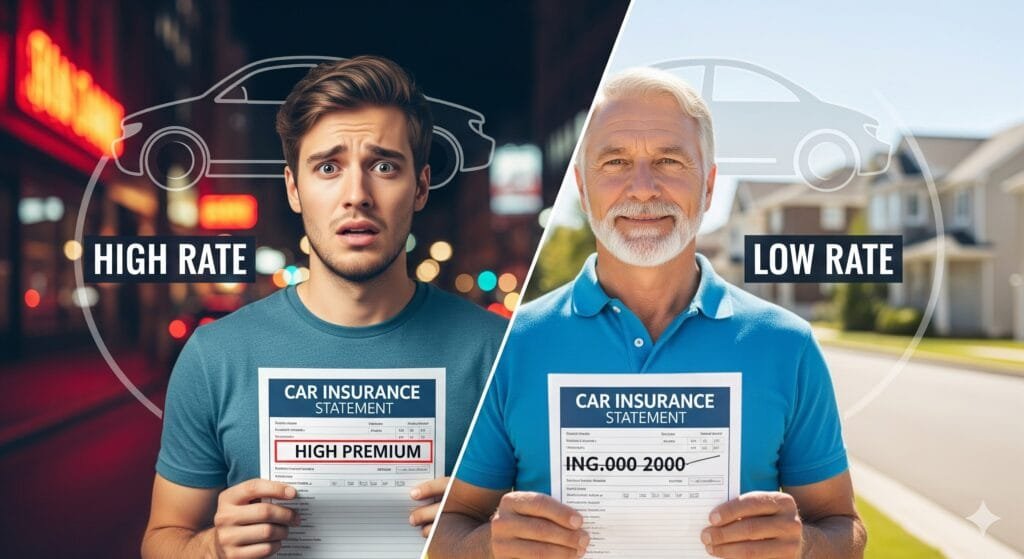
Lowest Rates for Young Drivers (Ages 16-25)
Young drivers are often considered higher risk due to their inexperience, which leads to higher insurance premiums. Shopping around for car insurance is crucial for finding affordable coverage in this age group.
Our analysis shows that GEICO offers the most competitive rates for 20-year-old drivers, with an average full coverage premium of $4,105 per year, or about $342 per month.
| Company | Median Annual Rate | Median Monthly Rate |
| GEICO | $4,105 | $342 |
| Progressive | $4,132 | $344 |
| Travelers | $4,134 | $345 |
| American Family | $5,217 | $435 |
| USAA | $3,657 | $305 |
Nerdy Tip: The easiest way for a young driver to secure a lower rate is to stay on a parent’s or guardian’s policy. This can lead to savings of thousands of dollars annually compared to having a separate policy.
Lowest Rates for Adult Drivers (Ages 30-50)
Drivers in their 30s and 40s usually enjoy some of the lowest car insurance rates, thanks to their years of driving experience and being considered a low risk by insurers.
For 40-year-old drivers, Travelers provides the best value for full coverage, with an average rate of $1,691 per year, or about $141 per month.
| Company | Median Annual Rate | Median Monthly Rate |
| Travelers | $1,691 | $141 |
| Progressive | $2,079 | $173 |
| GEICO | $2,249 | $187 |
| Nationwide | $2,411 | $201 |
| USAA | $1,575 | $131 |
Lowest Rates for Senior Drivers (Ages 60+)
Insurance rates for drivers in their 60s tend to stay relatively low. However, they may begin to rise slightly around age 70 as insurers account for age-related changes in vision and reaction time.
For 70-year-old drivers, Travelers is the most affordable large insurer, with an average full coverage rate of $1,660 per year, or about $138 per month.
| Company | Median Annual Rate | Median Monthly Rate |
| Travelers | $1,660 | $138 |
| Progressive | $1,857 | $155 |
| State Farm | $2,195 | $183 |
| GEICO | $2,229 | $186 |
| USAA | $1,394 | $116 |
How Your Driving History Impacts Your Insurance Bill
A clean driving record is your best tool for getting low insurance rates. Any blemish, from a minor ticket to a major accident, can increase your premiums for several years.
Lowest Rate Car Insurance After a Speeding Ticket
Even a single speeding ticket can cause your annual premium to rise, as insurers see it as a sign of riskier driving habits.
For drivers with a recent speeding ticket, Travelers offers the most affordable rates among major insurers, with an average annual premium of $2,219.
185 per month.
| Company | Median Annual Rate | Median Monthly Rate |
| Travelers | $2,219 | $185 |
| State Farm | $2,816 | $235 |
| Progressive | $2,944 | $245 |
| GEICO | $2,973 | $248 |
| USAA | $1,989 | $166 |
Lowest Rate Car Insurance After an At-Fault Accident
An at-fault accident is one of the most common reasons for a rate increase. This hike can last anywhere from three to five years, making it important to compare car insurance rates and find a provider that offers more lenient pricing.
Travelers provide the most competitive rates after an at-fault accident, with an average full coverage rate of $2,418 per year, or about $202 per month.
| Company | Median Annual Rate | Median Monthly Rate |
| Travelers | $2,418 | $202 |
| State Farm | $3,094 | $258 |
| Progressive | $3,346 | $279 |
| American Family | $3,765 | $314 |
| USAA | $2,398 | $200 |
Lowest Rate Car Insurance After a DUI
A DUI (Driving Under the Influence) is a serious violation that can significantly hike your car insurance rates. In some cases, insurers may even cancel your policy or refuse coverage altogether.
For drivers with a recent DUI, Travelers offers the most affordable rates among major companies, with an average full coverage rate of $2,987 per year, or around $249 per month.
| Company | Median Annual Rate | Median Monthly Rate |
| Travelers | $2,987 | $249 |
| Progressive | $3,014 | $251 |
| State Farm | $3,568 | $297 |
| American Family | $3,577 | $298 |
| USAA | $3,244 | $270 |
How a Poor Credit Score Can Increase Your Insurance Rates
In almost every state, insurance companies use a credit-based insurance score to help determine your rates. While this score is different from your regular credit score, it’s based on similar information. Statistically, people with lower credit scores tend to file more claims, so insurers charge them higher premiums.

Important Exception: California, Hawaii, and Massachusetts do not allow insurers to use credit scores to set car insurance rates.
For drivers with poor credit, Travelers offers the most affordable option, with an average full coverage rate of $3,005 per year, or about $250 per month. On average, drivers with poor credit pay 68% more for the same policy compared to those with good credit.
| Company | Median Annual Rate | Median Monthly Rate |
| Travelers | $3,005 | $250 |
| GEICO | $3,201 | $267 |
| Progressive | $3,580 | $298 |
| Nationwide | $3,582 | $299 |
| USAA | $3,004 | $250 |
Your Step-by-Step Guide to Getting the Lowest Car Insurance Rates
Finding the best car insurance rate is an ongoing process, but with a little effort, you can take control and maximize your savings. Here’s how you can do it:
Gather Your Information: To get accurate quotes quickly, make sure you have the following details for every driver and vehicle you want to insure:
- Full names and driver’s license numbers
- Vehicle Identification Numbers (VINs) for all cars
- The address where each vehicle is primarily kept
- Your current insurance policy to help compare coverages evenly
Decide on the Coverage You Need: You can choose between minimum liability and full coverage. If you go with liability, it’s highly recommended to get higher limits than what your state requires. This will help protect your assets in the event of a major accident.
Compare Quotes from Multiple Insurers: This is the most important step in saving money. Don’t settle for just one quote. Compare car insurance rates from at least three to five different companies. Include a mix of big national insurers (like those in our tables) and smaller, local ones that could offer more competitive rates in your area.
Ask About Every Available Discount: Don’t wait for insurers to offer discounts—ask about them! You may be eligible for savings you didn’t even know about. Common discounts include:
- Multi-Policy: Bundling your car insurance with a home or renters policy.
- Good Driver: For having a clean driving record over the past 3-5 years.
- Good Student: For young drivers who maintain a “B” average or better.
- Safety Features: For vehicles equipped with airbags, anti-lock brakes, or anti-theft systems.
- Low Mileage: If you drive less than the national average.
- Autopay/Paperless: For setting up automatic payments and receiving documents electronically.
Adjust Your Deductible: Your deductible is the amount you pay out of pocket when you file a claim before your insurance kicks in. Opting for a higher deductible (e.g., $1,000) can lower your monthly premium, while a lower one (e.g., $500) may increase your premium. Choose the deductible you can comfortably afford to pay if a claim arises.
Review Before You Commit: After you find a great quote, be sure to read the policy documents carefully. Double-check that all drivers, vehicles, and coverage amounts are accurate before finalizing your purchase.
Beyond the Price: What to Look for in a Car Insurance Company
While shopping for the lowest rate is smart, the cheapest car insurance isn’t always the best. A great insurance company provides more than just a low price. Here’s what else to consider:
- Customer Service: How easy is it to talk to a real person? Read reviews about the company’s customer service and support.
- Claims Handling: The most important job of an insurer is to pay claims fairly and efficiently. Look up a company’s claims satisfaction ratings from trusted sources like J.D. Power.
- Financial Strength: You need to know your insurer can afford to pay your claim, no matter how large. Check financial strength ratings from agencies like AM Best.
- Digital Tools: A good mobile app and website can make managing your policy, paying bills, and filing a claim much easier.
Methodology
The rates presented in this analysis were averaged from public filings obtained from Quadrant Information Services. We analyzed rates for 35-year-old men and women across all ZIP codes in all 50 states and Washington, D.C. Our base driver profile assumes a 2022 Toyota Camry LE, a clean driving record, and good credit. Full coverage includes liability, collision, and comprehensive coverage with a $1,000 deductible. All rates were refreshed in August 2025. Your individual rates will vary.
Frequently Asked Questions (FAQ)
Q: What is the fastest way to get cheap car insurance?
A: The fastest and most effective way is to use an online comparison tool to get car insurance quotes from multiple companies at once. This allows you to see your options side-by-side in minutes.
Q: What type of car is the cheapest to insure?
A: Generally, cars that are cheaper to repair, have excellent safety ratings, and are not frequent targets for theft have the lowest insurance rates. Family-friendly SUVs and minivans, like the Subaru Outback or Honda CR-V, often cost less to insure than sports cars or luxury vehicles.
Q: Does my insurance get cheaper as I get older?
A: Yes, for most of your life. Rates are highest for teens and typically drop significantly around age 25. They continue to decrease gradually and are often lowest for drivers in their 50s and 60s. After age 70, you may see rates begin to rise slightly.
Q: Is it okay to just buy the minimum required coverage?
A: While it is the cheapest legal option, it is risky. Minimum liability limits are often very low and may not be enough to cover all the costs if you cause a serious accident. If the damages exceed your policy limits, you could be sued and held personally responsible for the remaining balance.